(+44) 7967 889281
Telefonica

Telefonica is one of the largest telephone operators and mobile network providers in the world. It provides fixed and mobile telephony, broadband, and subscription television, operating in Europe and the Americas. The introduction of embedded SIM cards (eSIM) to replace old plastic Sims has required Telefonica to introduce new web based SIM registration processes allowing new and existing customers to install and register their new eSIM cards on line via Mobile or Desktop
THE PROBLEM
An eSIM (embedded-SIM) is a form of SIM card that is embedded directly into a device. Instead of an integrated circuit located on a removable SIM card, typically made of PVC, an eSIM consists of software installed onto an eUICC chip permanently attached to a device. Unlike conventional SIM, the installation process is completed by downloading the SIM card directly to the handset followed by a process that requires registration and activation of the SIM on-line by the customer via the network providers website. This process required a brand new User Journey flow to be designed and implemented across all Telefonica mobile brands.
RESEARCH
Competitive Benchmarking
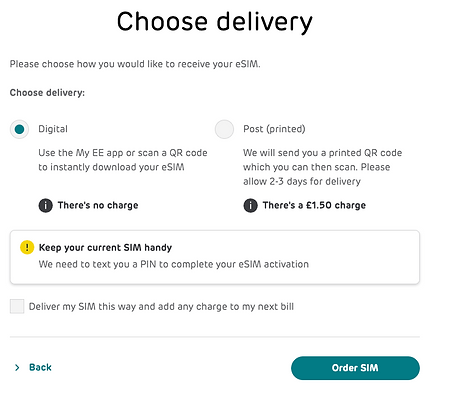
The first part of my research process was to look at how our main competitors are trying to solve the same problem. I reviewed the websites and mobile apps of other mobile networks including Virgin, EE and Vodaphone. I wanted to examine what they are doing really well that we could emulate and what they were doing not so well that we could improve on. It also gave me an opportunity to see what conventions have been established that we needed to follow.



Customer Interviews
I conducted interviews with existing eSIM users to discuss how they made the switch from plastic SIM cards to embedded SIM cards and how they found the transition process. We discussed chanllenges and fruststations they experienced durint the registartion and activation process. The interviews allowed me to gain a deeper insight into their goals, what their pain points were and what improvements they hoped to see if they neeed to go through the process agaain.

Usability Testing
We carried out a series of usability tests with users that were familiar with the SIM swap process who had previously switched from plastic SIM to eSIM as well as users that prefer to purchase their mobile plans on-line as opposed to entering a network provider store. Users were asked to carry out a series of primary tasks such as purchasing a new Tariff and a secondary task of registering the eSIM with the new tariff. The tests allowed me to learn the users goals, behaviours and context of use. All tests were recorded with permission of the users, including recordings of the user as well as their on-screen actions. Notes were taken during the sessions and during video playback.


ANALYSIS
Business Requirements and User Needs
With information gathered from Business Requirements and Interviews, Usability Tests & Benchmark Testing it was time to analyse the research and carry out ideation sessions within the UX team to form conclusions.
Research Conclusions
Following numerous discussions with the Product Owner, Stakeholders and Development teams, there was a general consensus that the following Design Solutions would form a solid foundation for the new Customer Journey
-
The ability to view details of available tariffs and the option to select multiple tariffs and add them to the customers basket
-
The ability to create a new user account during the checkout process
-
The ability to set up payment details
-
Users must be able to transition straight into the SIM registration process if they are purchasing a new eSIM
-
After the checkout users must have the ability to return to the site and login for registration at a time that suits them. The User Flow must support this requirement and navigate users to the correct step within the registration process.
-
Screen Designs will allow users to register multiple SIMs
-
eSIM registration must allow user the opportunity to upgrade their tariff during eSIM registration
-
During the registration flow a suitable step must allow users to transfer their existing number to the new tariff
-
Designs must allow users to select various identity checks via post, video or SMS
Backend Development teams & System Architects confirmed that the system infrastructure was currently in place to allow development of these requirements, proving they were feasible from a technical point of view.
SOLUTION DESIGN
User Flow Diagram
The first part of the design phase was to create a User Flow Diagram of the proposed solution. From the analysis phase it was clear that Navigation and Flow was a key element of the eSIM registration process. Users felt frustrated they were required to go through such a lengthy process and also call a contact centre in order to complete the registration process. The following flow diagram outlines the simplest path a user can take in order to register their new eSIM
.png)
Entry Point - User Notifications
.png)
Wireframes
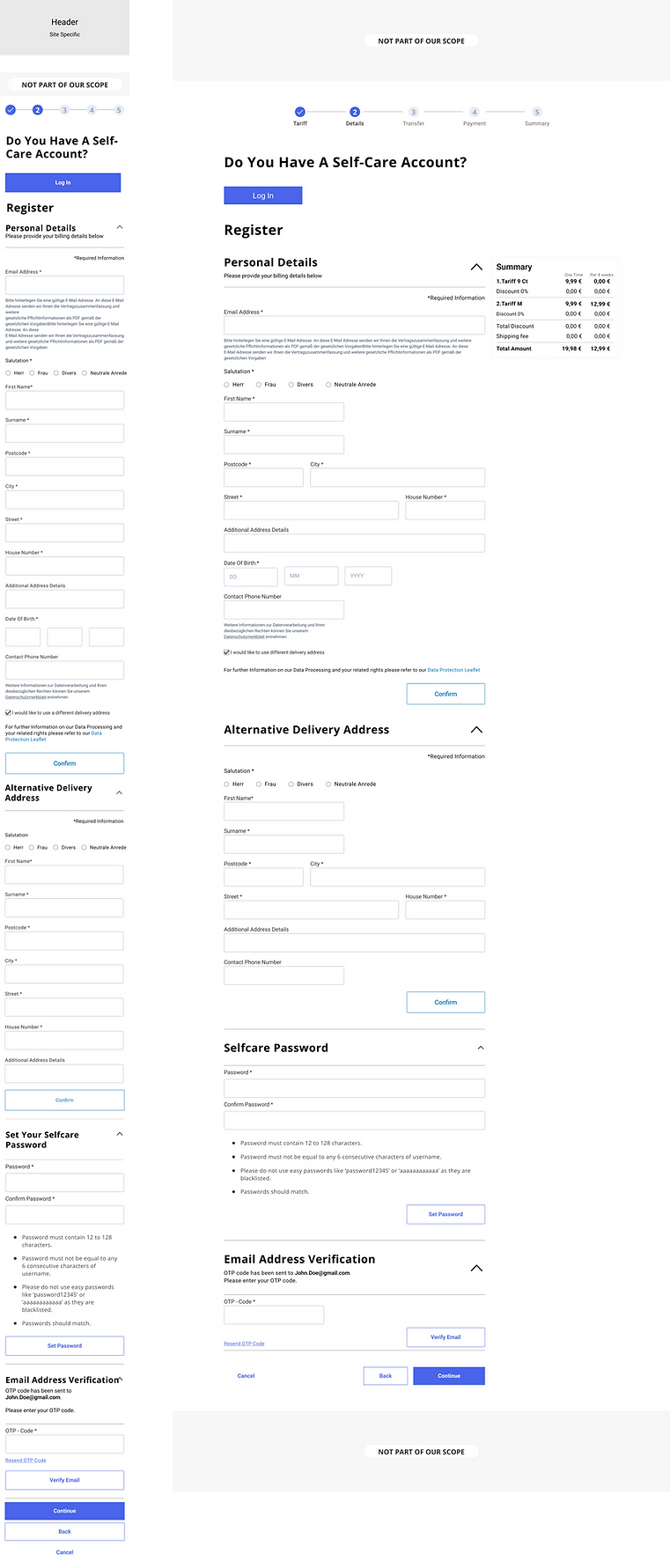
Using Figma I created detailed Medium Fidelity Wireframes that were presented to the Product Owners and Business Stakeholders. These wireframes were the basis for development work carried out to create an initial version of the eSIM registration process that was to be used across multiple Telefonica brands
Confirm Tariff
.png)
Personal Details
.png)
Number Transfer
.png)
Summary Page

Personalised Identification Process
.png)
UI Designs Development and Release to Production
Following the UX phase all designs were handed over to User Interface design team that created High Fidelity Wireframes which included branding and images. The final designs were signed off and handed over to Development Teams.